Inference Engine
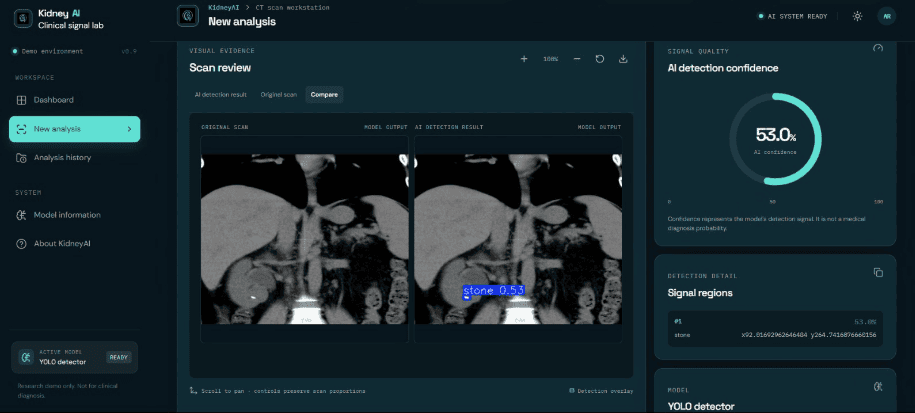
Upload CT scans (JPG, PNG, BMP, WEBP) to run high-speed YOLO detection tuned to an 896x896 resolution and 0.25 confidence threshold.
An end-to-end medical AI application that processes abdominal CT images using a custom-trained YOLO model to detect kidney stones, overlay confidence bounding boxes, track historical scans via SQLite, and export diagnostic PDF reports.
KidneyAI is a web-based AI assistant designed to streamline the identification of kidney stones in CT scan imagery. By replacing fragmented evaluation steps with an automated inference pipeline, it provides medical researchers and clinicians with accurate visual signals and instant report generation.
The system combines a lightweight React & TypeScript front end with a robust Flask back end, driving deep learning object detection (YOLO), persistent SQLite record archiving, and automated PDF document generation.
Interpreting abdominal CT scans for small or subtle kidney stones requires meticulous manual review. Medical professionals often need to cross-examine multiple slices, record coordinates, log patient history, and generate diagnostic summaries across disconnected tools.
The goal was to build an integrated pipeline that accelerates object identification, standardizes confidence metrics, and instantly consolidates findings into exportable reports without friction.
KidneyAI delivers an end-to-end workflow: CT images are validated, passed to a custom YOLO object detection network, rendered with bounding box overlays, saved to a SQLite database, and made downloadable as structured PDF reports.
Upload CT scans (JPG, PNG, BMP, WEBP) to run high-speed YOLO detection tuned to an 896x896 resolution and 0.25 confidence threshold.
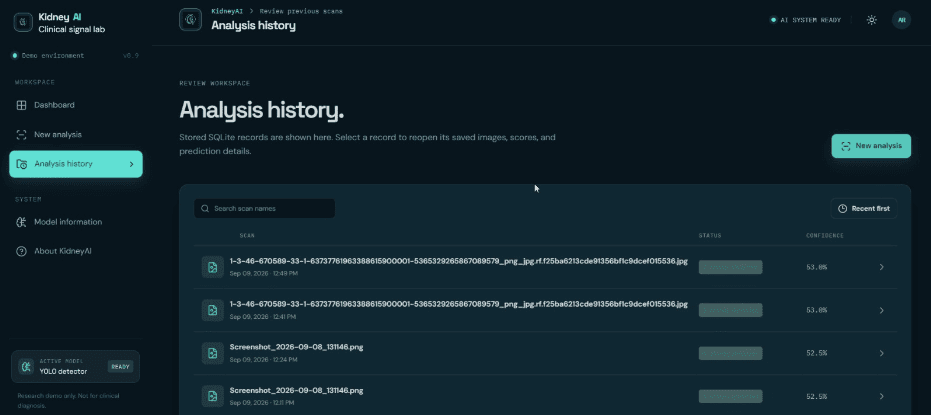
Persist detection metrics, stone counts, bounding box coordinates, and base64-encoded annotated images inside an SQLite database.
Generate professional A4 PDF reports via ReportLab containing scan images, confidence breakdowns, and diagnostic disclaimers.
Trained up to 100 epochs (converging at epoch 82) with an early-stopping patience of 20, optimized for CT slice contrast and feature extraction.
Automated image preprocessing scales CT inputs to 896×896, draws dynamic bounding boxes with confidence scores, and outputs MIME-formatted streams.
Seamless execution across environments with automatic hardware detection—leveraging CUDA GPU acceleration when available, with automatic CPU fallback.
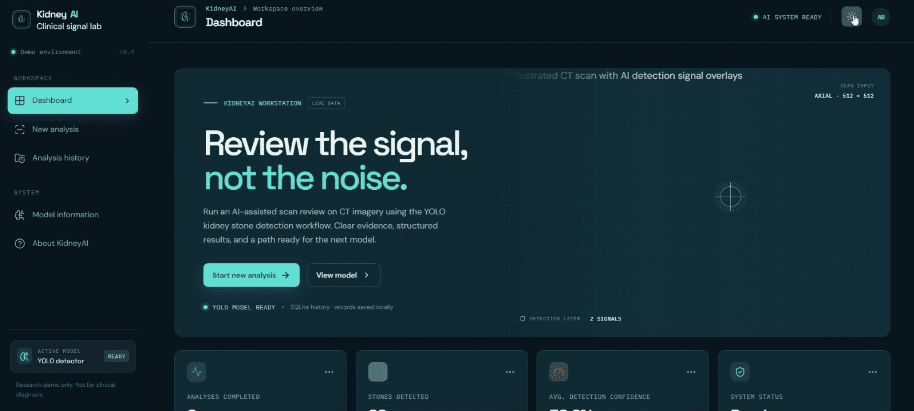
Designed using Tailwind CSS, TypeScript, and Lucide icons to present complex detection telemetry through intuitive dashboards, side-by-side scan reviews, and searchable history logs.
Strict payload checks limit file uploads to 10 MB and validate extensions (JPG, PNG, BMP, WEBP) before OpenCV execution.
Clean REST APIs (/predict, /history, /stats, /health) allow independent scaling of the Flask inferencing backend.
Built-in research disclaimers explicitly clarify AI detection limits for educational and demonstration purposes.
KidneyAI successfully demonstrates how computer vision models can be packaged into an intuitive application. The platform accelerates scan review cycles, automates record archiving in SQLite, and enables one-click PDF report generation.
Key takeaway: Combining fast deep-learning models (YOLO) with clean UI hierarchy creates an effective assistive tool for medical image evaluation.
Tell us what you are trying to make clearer, faster, or more capable.
Start a conversation